
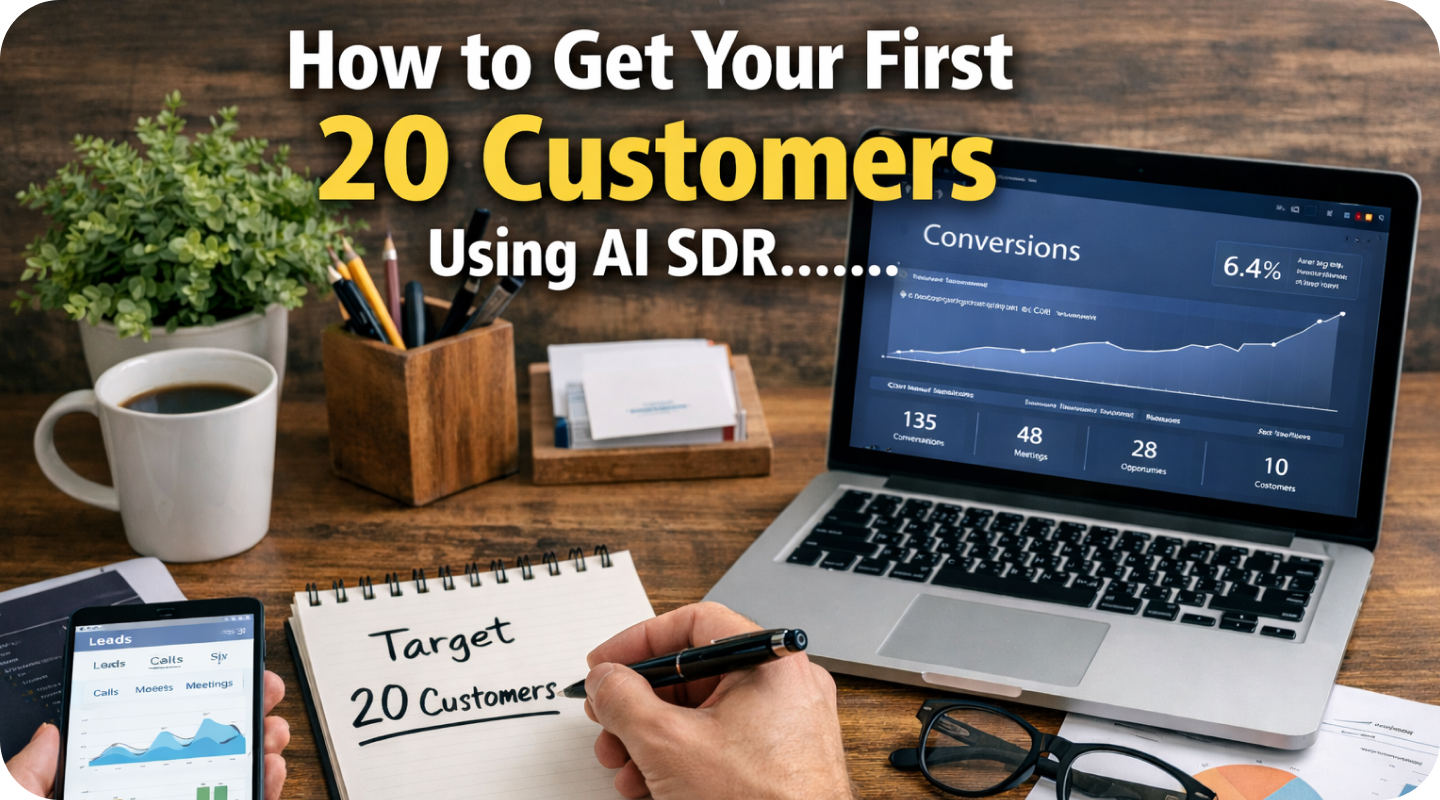
Getting your first 20 customers is not about scale.
It’s about clarity, speed, and learning fast.
At an early stage, you don’t need thousands of leads. You need:
- The right conversations
- Fast feedback loops
- Repeatable outreach
- Proof that someone will actually pay
This is where AI SDR automation becomes powerful. Instead of manually researching prospects, writing cold emails, and tracking follow-ups, founders can use AI to handle prospecting, personalization, and outreach — while they focus on closing.
Here’s a step-by-step framework to go from zero to your first 20 customers.
Step 1: Define Your Narrow ICP (Don’t Skip This)
Before automation, you need precision. Your Ideal Customer Profile (ICP) should answer:
- What industry?
- What company size?
- What job title?
- What specific pain?
- What trigger makes them ready now?
The narrower your ICP, the higher your reply rate. AI works best when targeting is sharp.
Step 2: Build a Focused Lead List (Quality > Quantity)
You don’t need 5,000 leads. Start with 100–300 highly relevant prospects from the same industry, growth stage, and with similar pain signals.
AI SDR tools can:
- Filter companies by hiring trends
- Identify tech stack usage
- Detect funding announcements
- Pull verified email data
Your goal isn’t volume — it’s precision. For your first 20 customers, relevance wins.
Step 3: Use Signal-Based Personalization
Generic emails won’t convert early customers. AI can personalize outreach using hiring signals, LinkedIn activity, recent funding, product launches, and tech stack detection.
That shift alone can double or triple replies.
Step 4: Keep Your Offer Simple
Early-stage founders often overcomplicate messaging. For your first 20 customers, focus on ONE clear outcome, one pain, and one transformation.
Bad: “We provide AI-driven multi-channel pipeline optimization.”
Better: “We help early-stage SaaS teams book more qualified demos without hiring extra SDRs.”
Clarity converts.
Step 5: Use a 3–5 Email Sequence (Not One Shot)
Most replies don’t happen on email #1. A simple AI SDR sequence includes:
- Email 1: Trigger-based opener
- Email 2: Social proof or case study
- Email 3: Objection handling
- Email 4: Breakup email
AI automates follow-ups, timing optimization, A/B testing subject lines, and tone adjustments. Consistency compounds.
Step 6: Prioritize Conversations Over Demos
Your goal is not to “sell” immediately. Your goal is to understand objections, refine positioning, and identify patterns.
Ask simple questions:
- “Is this relevant right now?”
- “How are you solving this today?”
- “What would make this valuable for you?”
Your first 20 customers are research partners as much as buyers.
Step 7: Iterate Weekly (Data > Ego)
AI SDR systems track everything. Every week, review what performed best and kill what doesn't work. Double down on what does. Iteration speed is your advantage.
Step 8: Manually Close, Don’t Automate Closing (Yet)
Automation gets you conversations. Founders should personally run early demos, handle objections, close deals, and collect testimonials.
AI handles scale. You handle trust.
Step 9: Turn Early Customers into Proof
Once you close 5–10 customers, capture testimonials and document case studies. Now your AI SDR can insert social proof to accelerate your path to 20 customers.
Step 10: Expand Gradually
After reaching 20 customers, expand to adjacent industries or broaden company size range. But don’t scale chaos. Scale what’s already working.
Example 30-Day Execution Plan
Week 1
- • Define ICP
- • Build 200-lead list
- • Write AI sequence
Week 2
- • Launch outreach
- • Track reply data
- • Book first calls
Week 3
- • Optimize messaging
- • Add social proof
- • Continue follow-ups
Week 4
- • Close early deals
- • Capture testimonials
- • Double down on best segment
Common Mistakes Early Founders Make
- 1.Targeting too broad an audience
- 2.Overcomplicating the product pitch
- 3.Sending one email and stopping
- 4.Automating before validating messaging
- 5.Ignoring data
AI SDR automation amplifies strategy. It doesn’t replace it.
Final Thoughts
Getting your first 20 customers isn’t about being perfect. It’s about fast experimentation, consistent outreach, clear positioning, and data-driven refinement.
AI SDR automation gives early-stage founders leverage that previously required a full sales team. Used correctly, it allows you to move faster, learn faster, and close faster.
Start narrow. Automate smartly. Iterate weekly.
Your first 20 customers are closer than you think.
Ready to find your first 20 customers?
Let AIVA handle the prospecting and outreach so you can focus on the conversations.