
What is an AI SDR?
An AI SDR (Artificial Intelligence Sales Development Representative) is a software-driven sales agent that automates outbound prospecting, lead qualification, follow-ups, and meeting booking.
Unlike traditional tools, AI SDRs don't just assist—they execute the entire outbound sales process autonomously.
Why CRM Integration is Critical for AI SDR
Your CRM is the heart of your sales operations. Without proper integration, even the most advanced AI SDR becomes ineffective.
Key Reasons Integration Matters:
- Centralized data management
- Real-time lead tracking
- Automated pipeline updates
- Improved personalization
- Accurate reporting & analytics
Popular CRMs AI SDRs integrate with:
- Salesforce CRM
- HubSpot CRM
- Zoho CRM
- Pipedrive
How AI SDR Integrates with Your Tech Stack
AI SDRs are designed to plug into your existing tools with minimal disruption. Here's how:
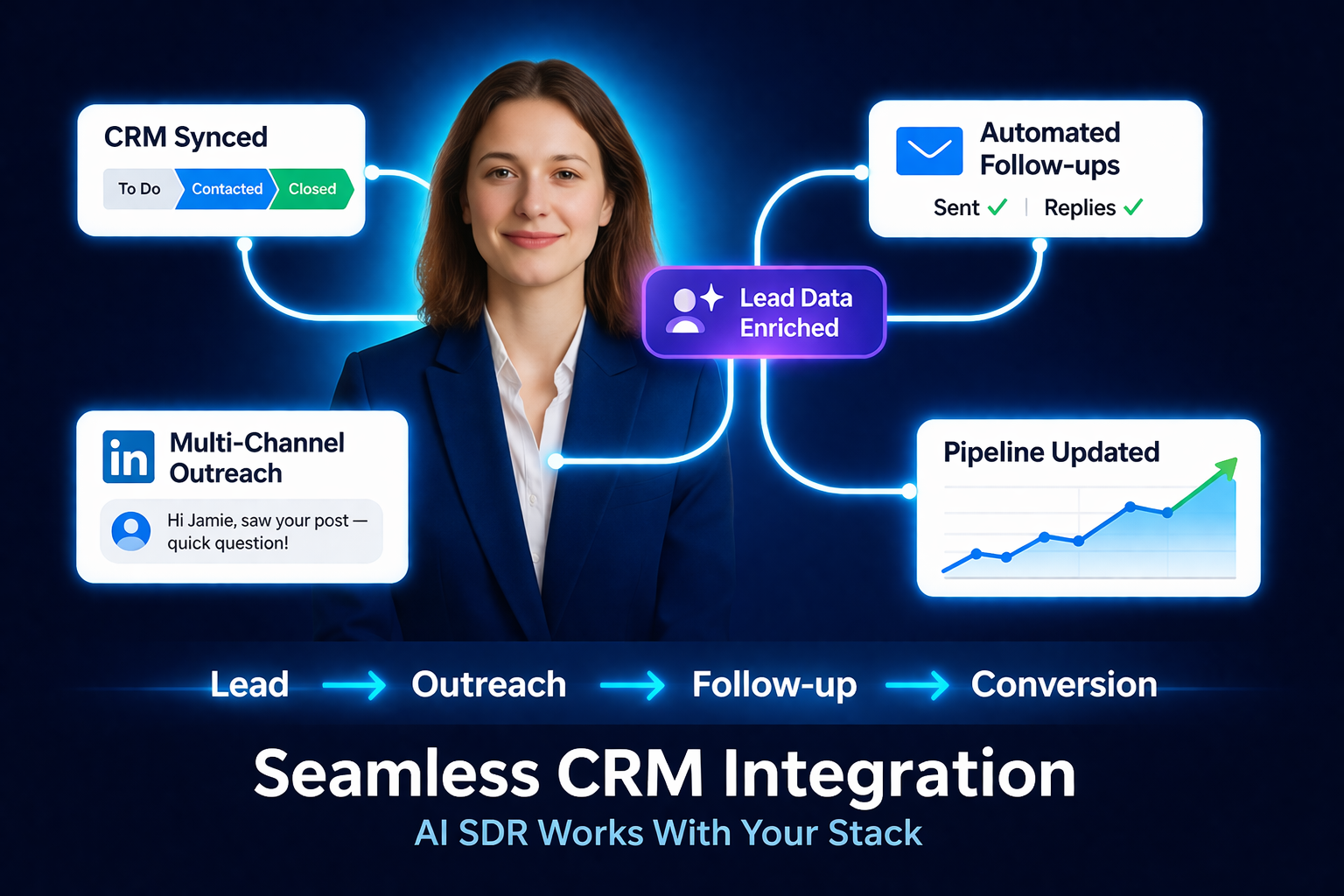
1. CRM Integration (Bi-Directional Sync)
AI SDR connects directly with your CRM using APIs.
What Happens:
- Pulls lead data from CRM
- Enriches contact information
- Pushes updates (emails, replies, meetings)
- Automatically updates deal stages
Example: A new lead enters your CRM → AI SDR instantly starts outreach → updates interaction history in real time.
2. Email & Outreach Tools Integration
AI SDR integrates with email platforms like Gmail and Outlook.
Capabilities:
- Sends personalized cold emails
- Tracks opens & replies
- Automates follow-ups
- Maintains human-like communication
3. Sales Engagement Platforms
Many AI SDRs integrate with tools like Outreach.io and Salesloft.
Benefits:
- Multi-channel outreach (email, LinkedIn, calls)
- Sequencing automation
- Campaign tracking
4. Calendar & Meeting Scheduling Integration
AI SDR syncs with Google Calendar and Calendly.
What it does:
- Checks availability
- Books meetings automatically
- Sends reminders
- Eliminates back-and-forth emails
5. Data Enrichment Tools
To improve targeting, AI SDR integrates with Clearbit, Apollo.io, and others.
Outcome:
- Better prospect insights
- Hyper-personalized outreach
- Higher reply rates
6. Communication Channels Integration
AI SDRs also connect with LinkedIn, SMS and WhatsApp APIs.
Use Cases:
- LinkedIn outreach automation
- Multi-touch campaigns
- Cross-channel follow-ups
7. Analytics & Reporting Tools
AI SDR pushes performance data into Google Analytics, Tableau, and BI tools.
Metrics Tracked:
- Open rates
- Reply rates
- Meetings booked
- Pipeline generated
- Revenue impact
Real-World Workflow Example
Here's how a fully integrated AI SDR system works seamlessly in the background:
- Lead enters CRM (e.g., HubSpot CRM)
- AI SDR enriches data using Apollo.io
- Sends personalized email via Gmail
- Follows up automatically if no reply
- Prospect responds → AI qualifies lead
- Books meeting via Calendly
- Updates deal stage in CRM
- Reports performance in Tableau
Integration Methods Used by AI SDRs
1. API-Based
- Most common method
- Secure and real-time data sync
- Scalable for growing businesses
2. Native Integrations
- Pre-built integrations with tools like Salesforce CRM
- Faster setup, less technical effort
3. Middleware
- Connects tools without coding
- Ideal for startups
Example tools: Zapier, Make
Benefits of AI SDR + CRM Integration
Increased Efficiency
Automates repetitive tasks like outreach, follow-ups, and data entry.
Better Lead Qualification
AI analyzes responses and prioritizes high-intent prospects.
Higher Conversion Rates
Personalized, timely outreach improves engagement.
Lower Customer Acquisition Cost (CAC)
Reduces dependency on large SDR teams.
Faster Sales Cycles
Instant engagement = quicker deal movement.
Common Challenges (And How to Solve Them)
1. Data Sync Issues
Solution: Use API-based integrations instead of manual imports
2. Poor Data Quality
Solution: Integrate enrichment tools like Clearbit
3. Over-Automation
Solution: Maintain human oversight for high-value deals
4. Tool Overload
Solution: Consolidate stack with an all-in-one AI SDR platform
Best Practices for Seamless Integration
- Start with one CRM integration first to ensure data flow is correct.
- Clean your CRM data before setup so AI doesn't learn from or act on bad data.
- Define clear workflows and triggers to avoid overlap between humans and AI.
- Monitor performance regularly and adjust messaging based on analytics.
- Align sales and marketing teams on who handles leads at which stage.
Future of AI SDR & CRM Integration
The future is moving toward fully autonomous revenue systems, where AI SDRs:
- Predict buyer intent
- Engage at the perfect time
- Optimize campaigns in real-time
- Integrate deeply across the entire revenue stack
Final Thoughts
AI SDR integration with your CRM and tech stack isn't just a technical upgrade—it's a revenue transformation strategy.
When done right, it creates a seamless system where:
Leads are captured
Engaged instantly
Qualified intelligently
Converted efficiently
All without manual intervention.
Join the AI SDR Revolution 🚀
Be among the first to access a fully autonomous AI Sales Agent that builds pipeline for you—24/7.