
Learning & Optimization
for AI Outbound
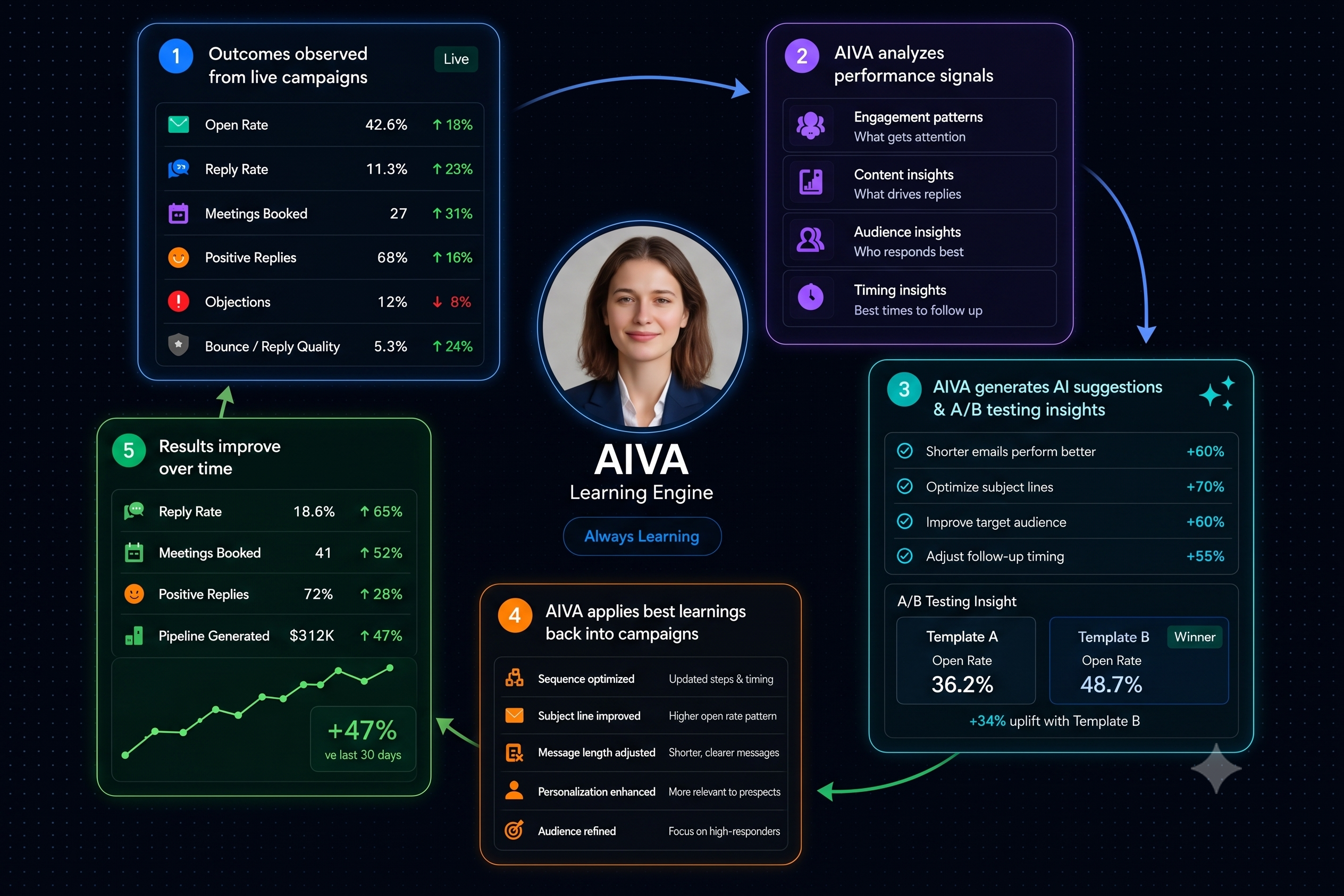
AIVA helps teams understand which templates, CTAs, channels, sequence steps, personalization sources, and segments are performing better — then uses reliable evidence to guide future drafts, Playbooks, and Campaigns.
Evidence-Based Execution. AIVA maps campaign reply patterns, channels, and CTA types back to your system configuration to constantly refine copy quality.
Outbound Teams Repeat What They Cannot Learn From
When sales execution tools operate in silos, team learnings are forgotten, and reps fly blind. AIVA restores context throughout the entire outbound lifecycle.
Weak Evidence
Teams often make optimization decisions based on too little sample data or insufficient send volume.
Vanity Metrics
High reply rates can be misleading and do not automatically translate into qualified sales pipeline.
Disconnected Insights
Template, channel, and lead source performance outcomes remain scattered across disparate tools.
No Confidence Labels
Outbound teams lack automated statistical checks to determine if a performance change is reliable.
Poor Future Reuse
Valuable outbound learnings are rarely institutionalized to automatically improve future playbooks.
Unchecked Assumptions
Campaign iterations are frequently driven by subjective intuition rather than verified win/loss data.
Turn Outcomes into Future Improvements
AIVA’s learning loop turns real campaign outcomes into practical recommendations. The goal is not to change what already happened. The goal is to make the next campaign smarter.
Approved Actions
AIVA sends or executes campaign actions through approved/runtime-safe workflows.
Outcome Tracking
Outcomes are tracked, such as replies, meeting intent, meetings booked, edits, rejections, and verifier results.
Downstream Attribution
AIVA attributes outcomes to templates, channels, sequence steps, personalization sources, and segments.
Confidence Guardrails
AIVA labels confidence and avoids overclaiming weak data.
Evidence-Based Recommendations
AIVA recommends improvements for future Playbooks, Campaigns, drafts, templates, and personalization strategy.
Traffic Shift
Auto Mode can shift future draft traffic where enough evidence and policy allow.
Where Learning Fits
in the AIVA Workflow
Learning & Optimization sits after real campaign outcomes. It helps AIVA understand what happened, what evidence exists, and what should change in future outreach.
Future Drafts Only
Approved drafts are protected.
AIVA never modifies drafts that have already been reviewed and approved by a human. Optimization insights are applied strictly to future playbooks, strategies, and drafts.Playbooks
Define outbound rules and campaign objectives.
Campaigns
Sequence outbound capacity and scheduling rules.
Draft Intelligence
Generate hyper-personalized cold outreach drafts.
Personalization Strategy
Select and score relevant target business signals.
Outreach Execution
Deliver mailings over secure email & LinkedIn channels.
Outcomes & Replies
Classify replies, meeting booking intent, and logs.
Learning & Optimization
Track statistical outcomes to isolate playbook evidence.
Dashboard Recomms
Suggest actions to improve playbooks and drafts.
Learning from the Signals
That Actually Matter
AIVA prioritizes meaningful sales outcomes, not vanity metrics. A template that gets fewer replies but more qualified meetings is much stronger than one that gets many low-quality replies.
Template Performance
Which templates perform better by channel, step, segment, and Playbook.
CTA Performance
Which calls to action lead to better replies, meeting intent, and meetings.
Sequence-Step Performance
Which steps create engagement or drop-off.
Channel Performance
How Email, LinkedIn, and InMail perform in their proper context.
Personalization Source Performance
Which sources generate better outcomes for specific audiences.
Personalization Depth Performance
Whether Personalize, Deep Personalization, or Hyper-Personalization is worth the effort.
Segment & Persona Performance
Which personas, industries, company sizes, or lead sources perform better.
Verifier Outcomes
Which messages fail or warn more often during validation checks.
User Action & Rejections
Which drafts need frequent edits, manual rejections, or regenerations.
Meeting Outcomes
Which messages successfully lead to meeting intent or booked calendar slots.
Negative Outcomes
Unsubscribes, DNC lists, not-interested replies, complaints, or negative sentiment.
Learning Behaves Differently
by Message Mode
Manual Mode keeps the user in control. A/B Testing compares two templates. Auto Mode can optimize future draft allocation, but only when enough evidence exists and only for future drafts.
Manual Mode
Analyze outbound outcomes to display conversion stats and suggestions inside dashboards.
Modify template copies, CTAs, channels, sequences, or traffic splits automatically.
A/B Testing Mode
Compare Template A vs Template B performance and recommend a winner when sufficient evidence exists.
Add extra template variations or declare a winner before significance metrics are met.
Auto Mode
Shift future draft generation traffic toward stronger templates as solid outcomes evidence accumulates.
Alter already-generated drafts, approved playbooks, or currently queued outbound messages.
AIVA Optimizes Future Drafts, Not Work You Already Approved
If your team approved a draft, AIVA should not quietly rewrite it later because new performance data appeared. Learning improves what happens next, not what was already reviewed or sent.
Confidence Labels
Prevent False Winners
AIVA should not call something a winner just because it performed well once. Learning insights need confidence labels so teams understand how much evidence supports each recommendation.
Evidence is useful and shows a clear pattern, but not fully conclusive across all segments.
Learn Which Messages & Steps
Move Prospects Forward
AIVA helps teams understand whether a template, CTA, sequence step, follow-up angle, or subject line is actually moving prospects toward a meaningful next step — not just creating activity.
Template Learning
Understand which email and message templates perform better by channel, step, segment, and Playbook.
CTA Conversion
Identify which calls to action generate genuine meeting intent versus simple casual replies.
Subject Line Patterns
Track which subject-line structures support stronger open and reply performance across segments.
Follow-Up Angles
Analyze multi-touch angle variations to see which follow-up angles work without sounding repetitive.
Sequence-Step Impact
Evaluate step contribution to identify which touchpoints generate meetings and which cause drop-off.
Final Nudge Utility
Determine whether close-the-loop messages recover lost conversations or should be adjusted.
Learn Which Personalization Is Worth Using
Deeper personalization is not always better. AIVA should learn when a simple role/company hook is enough, when Deep Personalization improves relevance, and when Hyper-Personalization is worth the extra effort.
Website Intelligence
Performs best for SaaS founders. Company positioning signals may work better for that audience.
Funding Signals
Work only when recent. Old funding data should not drive personalization.
Enterprise InMail
Hyper-Personalization improves enterprise InMail. Deep research may be worth it for high-value leads.
Deep Personalization
Matches Hyper performance at lower AI usage. Teams may save AI usage without losing quality.
Mutual Location
Performs weakly for broad campaigns. Location may be too generic for that audience.
Understand What Works by Channel, Persona, and Segment
AIVA should compare performance in context. Email, LinkedIn, and InMail do not always measure success the same way, and different personas or segments can respond differently to the same message.
Email & Sequence Insights
Cold Email Intro
"Cold Email Intro delivers 3.2x higher meeting intent for VP Sales personas when emphasizing CRM writeback on Day 0."
Multi-Touch Sequence
"Shifting to a soft social-proof follow-up angle on Step 4 recovers 28% of quiet conversations across Growth personas."
LinkedIn Outreach Insights
LinkedIn First Message
"LinkedIn First Message is performing better for founder personas after a 2-day wait, but confidence is still low."
LinkedIn InMail
"InMail outreach drives peak acceptance among Enterprise IT leads when referencing security compliance signals."
Learning Should Appear Where
Teams Make Decisions
Learning is most useful when it appears at the moment of decision — when teams choose templates, configure campaigns, review drafts, and analyze results.
Playbook Templates
Template usage, reply quality, meeting rate, edit rate, confidence, and AI recommendation tags.
Playbook Sequence Builder
Template, depth, source, channel, and step performance while configuring steps.
Campaign Builder
Historical performance, expected learning behavior, A/B test warnings, and Auto Mode confidence.
Drafts Tab
Why this template/source was selected and whether Learning influenced selection.
Campaign Dashboard
Channel, sequence, template, source, and meeting outcome insights.
AIVA Chat
Plain-language explanation of what is working and what to improve.
Admin / Ops
Support-safe traceability, weak-data state, and troubleshooting context where relevant.
Ask AIVA What to Improve Next
AIVA helps your team understand template performance, statistical confidence, sequence step drop-offs, and next-step actions.
AIVA translates complex learning telemetry and outcome signals into plain-language answers and actionable recommendations — guided through a simple chat experience.
AIVA explains what is working, why it happened, and what action makes sense next.

AIVA
Learning & Optimization Co-pilot
Hi! I’m AIVA, your Learning & Optimization co-pilot. Ask me what to improve next!
Built for Evidence-Based Improvement,
Not Guaranteed Results
AIVA helps teams learn from real outcomes and make smarter outbound decisions, but we do not make false guarantees or hype promises.
Learning Works Across the
AIVA Workflow
Learning & Optimization feeds outcome intelligence into every stage of AIVA's outbound compilation pipeline. Explore related system workflows.
AI Draft Intelligence
Learning guides future draft decisions and template selection.
Personalization Intelligence
Learning tracks source and signal performance.
Multi-Channel Campaigns
Campaign outcomes feed learning.
Chat with AIVA
AIVA explains what is working and what to improve.
Native Meeting Booking
Meeting intent and booked meetings are key outcome signals.
CRM Continuity
CRM outcomes can support deeper performance attribution where configured.
LinkedIn & InMail Outreach
Channel-specific outcomes need proper attribution.
Trust & Security
Learning must respect approvals, permissions, and explainability.
Lead Database
Lead source and segment quality affect performance.
Commercial Planning
AI usage and optimization behavior may affect commercial planning.
Ready to Make Every Campaign
Smarter Than the Last?
See how AIVA helps your team learn from campaign outcomes, compare templates, evaluate personalization sources, understand channel performance, and improve future drafts and Campaigns with confidence-aware recommendations.